AI and Space
Machine Learning for Field Robot Control
Robots operating in real-world environments require flexible control that can adapt to uncertainty. However, AI methods, including reinforcement learning, are fundamentally designed to become intelligent through experience, which means that they often struggle with situations they have not previously encountered. Our laboratory investigates reinforcement learning methods for enabling such flexibility in field robots.
Self-Localisation Algorithms for Planetary Explorers
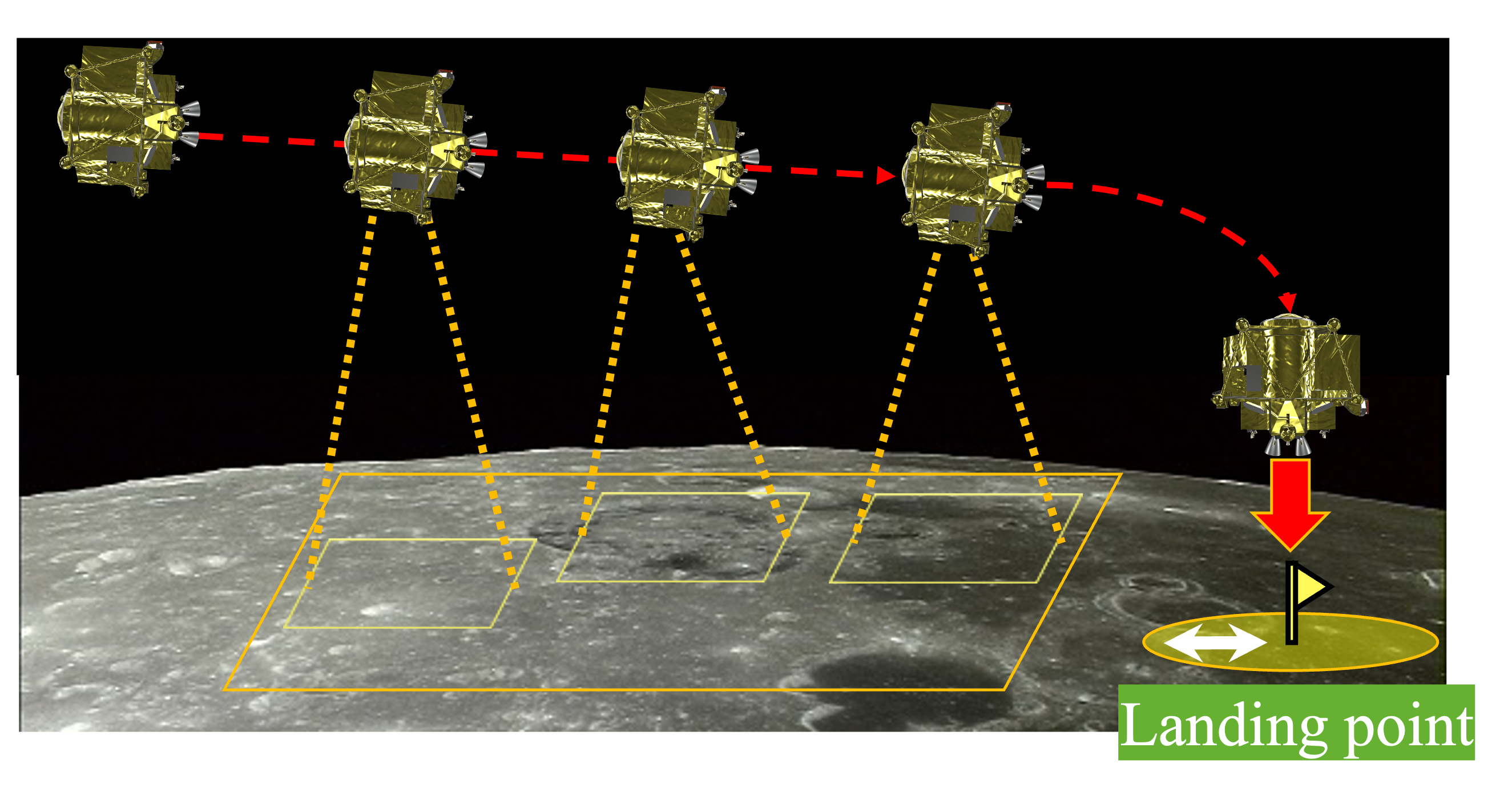
In the past, our faculty member investigated self-localisation algorithms for a lunar lander in the SLIM (Smart Lander for Investigating Moon) project launched by JAXA. One of the main pillars of this project was the demonstration of pinpoint landing technology based on real-time trajectory correction using image matching navigation. As the term image matching suggests, the method estimates the lander's position by matching crater patterns in lunar surface images with a pre-loaded crater map and measuring the deviation from the planned trajectory. In the self-localisation method to which our faculty member contributed, triangles are first formed from craters and matched as shown below. Then, based on the matched triangles, outlier craters are matched, and the lander's position is calculated from the coordinates of the matched craters.
Although the SLIM mission has already been completed, our laboratory continues to work on remaining challenges and aims to address them using AI-based approaches.